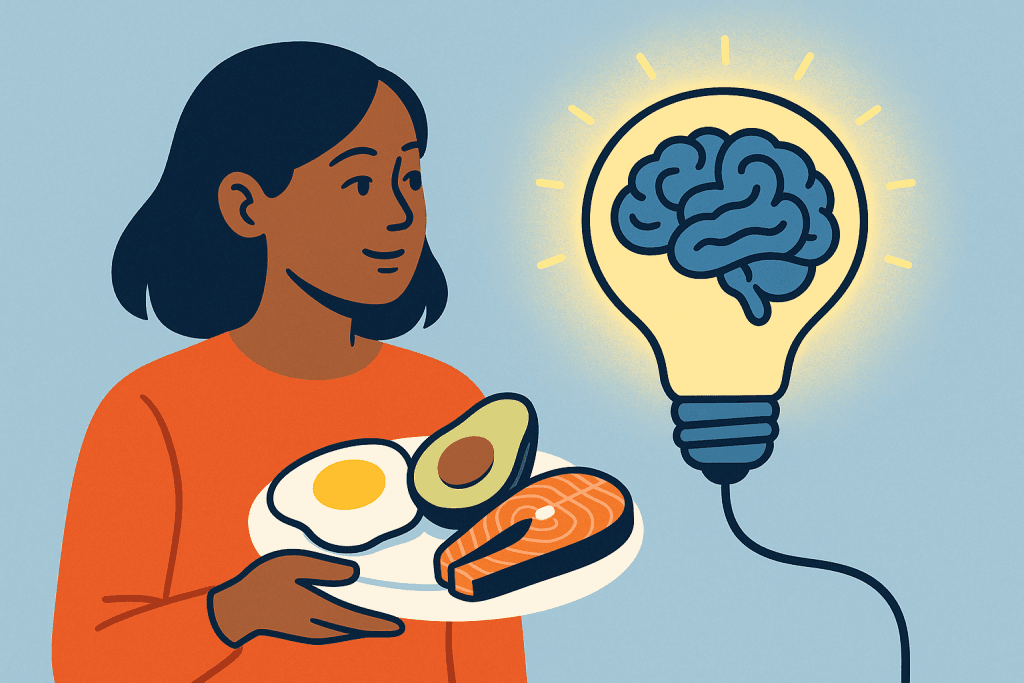
Keto did not deliver a clean brain upgrade in a small group of university students. It made them faster on several timed tasks, but it also made them less accurate when the work demanded careful working memory and higher-order reasoning.
What the Foggia study actually tested
The clearest version of this story comes from a small experiment at the University of Foggia in Italy. Researchers started with 30 participants, but only 8 undergraduate students completed both baseline and follow-up testing after three weeks on an isocaloric ketogenic diet, meaning calories were controlled rather than simply cut.
That design matters. Because the diet was not just a lower-calorie reset, the findings point more toward ketosis and diet composition than toward weight loss alone. The study was built to see whether keto changes how healthy young adults think and perform, and the answer was not a simple yes or no.
Where speed moved up
The strongest signal was faster performance. At follow-up, the students moved more quickly on the Digit Symbol Test, the Trail Making Test, the Stroop Task, and the math-operation part of the Automated Operation Span Task.
In plain English, that pattern suggests quicker visual-motor processing and faster mental execution. If you think of the kind of snap judgment and rapid symbol matching that shows up in timed classroom work, the diet may have nudged performance in that direction. For keto fans, that is the intriguing part: the diet seemed to sharpen pace.
Where precision slipped
The trade-off showed up when the task got more demanding. The same students were less accurate on working-memory tasks after the ketogenic phase, especially on the Automated Operation Span Task, where quick math and memory demands collide.
That is the central wrinkle in the story. Faster reaction time can look impressive on paper, but if it comes with weaker accuracy on harder reasoning tasks, the practical value becomes less obvious. A quicker answer is not necessarily a better one, especially when the job is to hold information in mind and manipulate it carefully.
The researchers also reported no difference in anxiety between baseline and follow-up. That helps narrow the interpretation: the changes do not appear to be explained by a simple mood shift.
Why this matters for the keto crowd
This is exactly the kind of finding that can sound bigger than it is. The study is promising, but it is still preliminary because only eight students completed the full protocol. With a sample that small, the result is best read as a signal to investigate, not a verdict on keto as a brain hack.
Even so, the paper is relevant to real-life keto conversations because it focuses on healthy young adults in a setting that resembles student life. If you are using keto while studying, working, or trying to stay sharp through a long day, the question is not just whether your brain gets “better.” It is which kind of performance changes, and whether speed helps more than accuracy hurts.
How this fits the broader science
Keto is not new to medicine. High-fat, low-carbohydrate ketogenic diets have been used for epilepsy for almost a century, with foundational reports dating back to 1921. That long clinical history is one reason the diet still gets serious attention, even as it has become popular far beyond seizure treatment.
The cognition literature, though, is still mixed. A 2023 systematic review in Nutritional Neuroscience identified 49 relevant studies, including 27 human studies. More than 80% of the human studies reported favorable cognitive effects, but the review also stressed the field’s weaknesses: small samples, weak controls, and limited objective measures of cognition.
A newer human study adds another layer. In Physiology International, researchers reported that a four-week non-energy-restricted ketogenic diet improved processing speed, semantic memory, working memory, episodic memory, fluid cognition, crystallized cognition, and overall cognitive composite scores in 108 sedentary healthy adults. Blood ketones rose from 0.12 to 1.32 mmol/L in the ketogenic group, showing that the diet did what keto is supposed to do biologically.
Put those findings next to the Foggia student study and the message gets more interesting, not less. Keto may help some cognitive domains in some populations, but the pattern can shift depending on who is studied, how the diet is designed, and which task is being measured. A diet that looks helpful on one cognitive test can look more complicated on another.
The real takeaway is not that keto is a proven nootropic. It is that ketosis may change cognition in task-specific ways, sometimes making people quicker without making them more precise. That is a meaningful distinction for anyone who wants the diet to improve studying, focus, or productivity, because the thing that feels like a boost in a lab may turn out to be a trade-off once the work gets harder.
Every story on Keto Diet Magazine is assembled by an automated editorial system that works from verified research, official records, and credible reporting, then clears automated accuracy and moderation checks before it goes live. The standards that system follows are set and overseen by the people who run the publication. Read our full editorial policy.
Did this article answer your question?