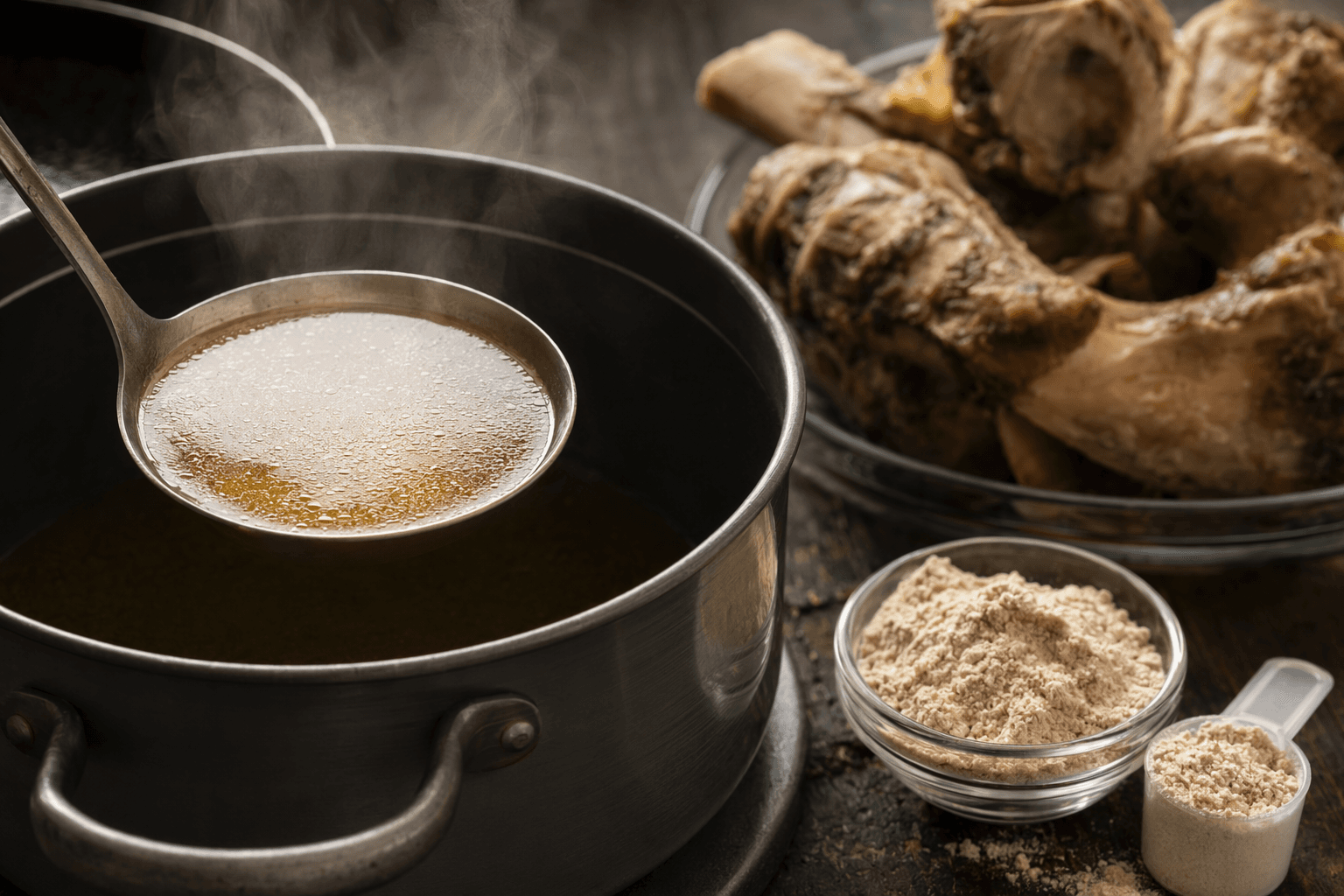
Bone broth is being sold as the original collagen supplement, and keto readers should notice the gap between a simmered food and a polished scoop. In a May 13, 2026 piece on Kiltz Health, Dr. Robert Kiltz argues that broth may deliver collagen benefits more practically than expensive powders, because it arrives as a whole food rather than a processed wellness product.
Why broth keeps winning the food-first argument
Cleveland Clinic dietitians Kate Patton and Anthony DiMarino say bone broth contains collagen, amino acids, and minerals, and may help support skin, strong bones, gut health, and joint pain. They also stress that it is not a silver bullet, which is the part keto readers should keep in mind when a wellness trend starts sounding too tidy.
That broader, food-first framing helps explain why broth keeps showing up in paleo circles and why it has long been a staple of Asian cooking. Homemade or café-made broths are generally more reliable than some commercial versions, Cleveland Clinic notes, but nutritional quality still varies from batch to batch. For keto, that makes broth appealing for more than collagen alone: it adds flavor, richness, and a savory base that fits low-carb eating without feeling like a supplement ritual.
What bone broth can give you, and what it cannot
The promise behind broth is not just that it contains collagen. It is that a slow-simmered food may deliver a mix of nutrients in a form the body can actually use, while also feeling like real nourishment. That is why the Kiltz Health piece leans into broth as a better fit for reproductive health and cellular repair, and why the message lands so well in ancestral-nutrition and carnivore conversations.
Still, the clinical picture is more restrained than the marketing. Harvard Health Publishing says bone broth can supply some collagen, but not much. Its position matches the more measured view: broth can be part of a healthy pattern, but it should not be mistaken for a concentrated collagen strategy. If you are chasing the specific amino acids tied to collagen, the distinction matters.
Why the lab data keep favoring powders
The sharpest reality check comes from a 2019 study in the International Journal of Sport Nutrition and Exercise Metabolism. Standardized bone broth preparations had significantly lower levels of collagen-related amino acids, including hydroxyproline, glycine, proline, hydroxylysine, leucine, and lysine, than a potentially therapeutic 20 g dose of reference collagen supplements. The authors concluded that bone broth is unlikely to provide a consistently reliable source of key collagen precursors.
That is the central split in this debate. Broth may be the better food, but it does not automatically deliver the same measured dose as a collagen powder. Harvard Health says collagen supplements may help skin elasticity, hair and nails, joint pain, bone density, and muscle mass, although larger studies are still needed. For readers who want a clear, repeatable intake, broth is hard to standardize in the same way a scoop can be.
Bioavailability is where hydrolyzed powders make their case
The supplement industry does not ignore that problem. A 2024 Frontiers in Nutrition clinical study found substantial uptake of hydroxyproline after oral collagen-hydrolysate ingestion, which helps explain why manufacturers keep pushing hydrolyzed collagen. Once collagen is broken down into smaller peptides, it becomes easier to study, easier to dose, and easier to market as a targeted bioavailable ingredient.
That is also why the collagen category keeps growing. Future Market Insights estimated the collagen supplement market at USD 1.80 billion in 2025 and projected it to reach USD 3.56 billion by 2036. It also said hydrolyzed collagen would lead the product type segment with about 63.7 percent share in 2026, while powders would lead form type with about 58.4 percent. In other words, the market is built around convenience and precision, not around simmering bones.
The marketing problem is bigger than one mug or one scoop
A 2021 review by Rebekah D. Alcock, Gregory C. Shaw, Louise M. Burke, and colleagues found that skin, hair, and nail supplements are widely marketed despite weak evidence. Many products rely on claims that are not verified by independent testing, FDA review, or high-quality randomized trials, which is exactly the kind of fine print keto shoppers tend to miss when a product promises beauty, recovery, and metabolic support all at once.
That is why the bone broth versus powder question is really a question about evidence quality, not just preference. Broth wins on being a recognizable food, on culinary value, and on the kind of satiety that comes from a warm, savory cup. Powders win on measured dosing, portability, and the stronger evidence for hydrolyzed forms and amino-acid uptake.
How to choose in a keto kitchen
If you want the most food-first, keto-friendly option, broth makes the cleaner case when you are after something savory, simple, and useful in a real meal pattern. It can be made from inexpensive scraps that would otherwise be discarded, so it also has a cost advantage that expensive powders cannot match in spirit or in practice.
If you want a more standardized collagen strategy, a powder is easier to quantify and easier to fit into coffee, shakes, or a fast. The tradeoff is that you are paying for convenience and formulation, not for a whole-food experience. Sodium and mineral content can also vary more in broth from batch to batch, so commercial labels and homemade recipes deserve a closer look than many keto shoppers give them.
Bone broth may be the more satisfying, more culinary answer for keto, but the collagen aisle still belongs to powders when the goal is a consistent dose. That is the real takeaway behind the original collagen supplement story: the pot on the stove can make a stronger food choice, but the scoop still owns the sharper evidence.
Every story on Keto Diet Magazine is assembled by an automated editorial system that works from verified research, official records, and credible reporting, then clears automated accuracy and moderation checks before it goes live. The standards that system follows are set and overseen by the people who run the publication. Read our full editorial policy.
Did this article answer your question?