What this study actually asked
A549 lung cancer cells under low-glucose conditions did not just behave differently, they left a measurable chemical signature behind. The Scientific Reports paper from an Iran University of Medical Sciences team, including Farzad Izak Shirian, Nahid Safari-Alighiarloo, Ali Mohebbi, Seyyed Mohammad Tabatabaei, Ali Karami, Mohammad Amin Vaezi, Aisa Bahar, Vahid Salimi, and Masoumeh Tavakoli-Yaraki, set out to see whether a ketone-rich, glucose-poor environment creates a distinct metabolic fingerprint. That is a very specific question, and it is the right way to read the paper: as mechanistic cancer biology, not as a diet prescription.
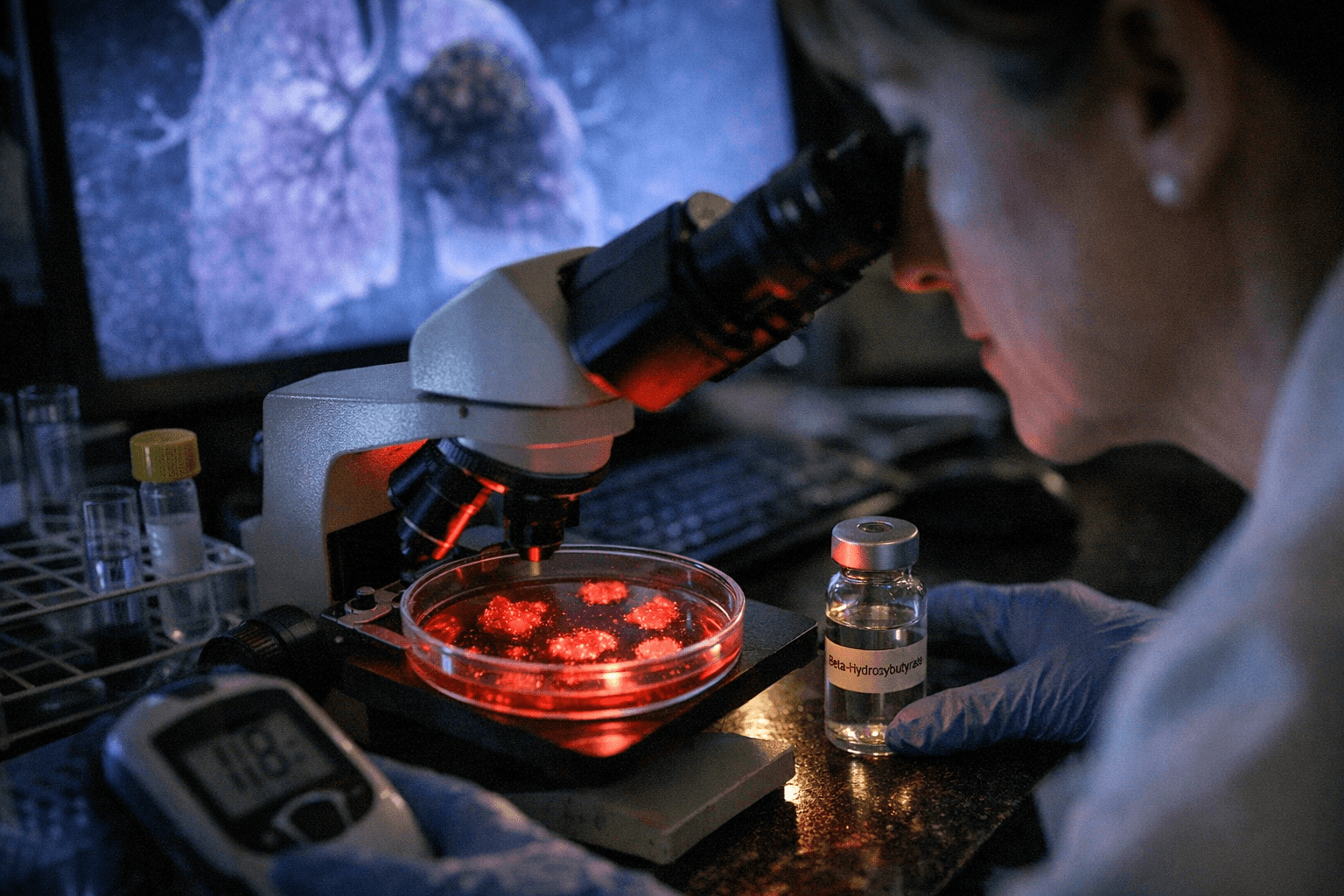
The setup was metabolomics, not a feeding trial in people. The researchers cultured A549 cells under varying glucose concentrations, with or without beta-hydroxybutyrate, then used LC-MS/MS to quantify 20 amino acids and 30 acylcarnitines in the conditioned media. In plain keto-language, they were asking what happens when you take away glucose, add BHB, and watch how the cells handle their fuel economy.
What changed when glucose dropped and BHB entered the picture
The clearest result was that the experimental groups clustered apart from one another based on extracellular metabolite profiles. That matters because it shows substrate availability was enough to reshape the cells’ visible metabolic behavior in a structured way, not just with random noise. The medium became a kind of metabolic calling card, revealing how the cells were pulling in, releasing, or using nutrients.
The standout pattern in the glucose-restricted, beta-hydroxybutyrate-supplemented group was a drop in tryptophan and a rise in arginine. That combination suggests the cells were altering amino-acid handling under stress, but the authors are careful here: these measurements came from the culture medium, not from inside the cells themselves. So the readout tells us about uptake, secretion, or utilization, not about a fully mapped intracellular pathway.
Short-chain acylcarnitines also rose across comparisons, which points toward broader changes in fatty-acid handling and energy metabolism. For keto readers, that phrase will sound familiar, because acylcarnitines often enter the conversation when cells are adjusting how they shuttle and burn fat-derived fuel. In this paper, though, the signal is not “fat is curing cancer,” it is “the cancer cells are metabolically reprogramming themselves under nutrient pressure.”
Why this is not a clinical keto victory lap
This is the part where the petri dish has to stay in the petri dish. The paper does not show that a ketogenic diet helps lung cancer patients, and it does not show that ketosis is safe, unsafe, or even relevant as a treatment in people with lung cancer. It shows that under controlled lab conditions, A549 cells responded to glucose restriction plus BHB with a different extracellular metabolic pattern.
The authors themselves note that functional studies are still needed to establish biological relevance. That is the crucial gap between metabolite signatures and real-world outcomes like tumor growth, survival, drug response, or disease progression. A changed amino-acid profile is interesting; it is not the same thing as proof of benefit, harm, or therapeutic effect in humans.
How this fits into the bigger ketone biology debate
This paper lands in a messy, fascinating corner of cancer metabolism where ketones are not automatically friend or foe. A 2024 Molecular Biology Reports study from the same research group found that BHB triggered apoptosis, mitochondrial impairment, and oxidative stress in A549 cells under long-term glucose restriction. In that model, BHB looked more like a stressor than a rescue fuel.
But a 2025 Cell Metabolism paper tells a different story in a different lung-cancer context. It found that lung tumor-initiating cells could switch from glucose to ketone utilization under glucose deprivation, and that a ketogenic diet expanded the TIC pool while also creating a vulnerability to MCT1 inhibition. That is an important reminder for the keto community: cancer metabolism is not one simple switch. The effect of ketones can depend on cell type, tumor state, nutrient context, and even which transporter or pathway the cells rely on.
A separate public-health warning also keeps the conversation grounded. A 2024 Columbia cancer-center explainer highlighted a mouse study in which a ketogenic diet reduced primary breast-tumor growth but increased lung metastases. That is exactly why experts keep stressing caution around dietary ketosis in oncology. The signal can change with the model, the tissue, and the outcome you care about.
What keto readers should take from it
For people who follow keto, the most useful takeaway is not a headline about “ketones fighting cancer.” It is that beta-hydroxybutyrate and low glucose can reshape cancer-cell metabolism in ways scientists can measure, and those shifts may expose vulnerabilities or adaptive tricks. The study adds another layer to the growing idea that ketone biology matters in oncology, but it does so in a very early, experimental way.
If you want the cleanest reading, it is this: the cells changed their amino-acid and acylcarnitine patterns when glucose was restricted and BHB was added, with tryptophan falling, arginine rising, and short-chain acylcarnitines increasing. That tells us the metabolic landscape shifted. It does not tell us that a keto diet should be used to treat lung cancer, and it does not tell us that it should be avoided as a blanket rule either.
The field still needs human evidence, and that is where the real answer will have to come from. Until then, this study is best understood as a sharp, carefully drawn map of how lung cancer cells adapt when glucose is scarce and ketones are on the table.
This article was produced by Prism’s automated news system from verified source data, official records, and press releases, then run through automated quality and moderation checks before publishing. The system is built and supervised by the people who set the standards it runs under. Read our full AI policy.
Know something we missed? Have a correction or additional information?
Submit a Tip

%3Amax_bytes(150000)%3Astrip_icc()%2F1036682-d776599ed42a484b88430e2a23025ed2.jpg&w=1920&q=75)