Keto’s most interesting cancer story right now is not about starving tumor cells out of existence, it is about the gut ecosystem underneath them. A letter to the editor in Cell Proliferation from a Soochow University-linked team in Suzhou lays out a gut microbiota-MMA-immune axis that could help explain how carbohydrate restriction changes colorectal cancer biology. That is a useful lab clue, but it is not a human diet trial, and it is definitely not a green light to treat colorectal cancer with keto alone.
What this paper adds
The paper, with corresponding author Songbing He, was received on December 26, 2025, revised on May 22, 2026, and accepted on June 3, 2026. Its starting point is the sheer scale of the disease: about 1.93 million new colorectal cancer cases occur worldwide each year, and in the United States the American Cancer Society projects 158,850 new cases and 55,230 deaths in 2026. CRC remains the second-leading cause of cancer death in the U.S. and the leading cause of cancer death in adults younger than 50, with Alaska Native people carrying the highest incidence and mortality rates.
That burden is why this kind of mechanistic paper gets attention. It is not claiming keto cures anything. It is asking a narrower, smarter question: if keto shifts the gut microbiome, could that alter the tumor environment in a way that matters for colorectal cancer?
The pathway researchers are proposing
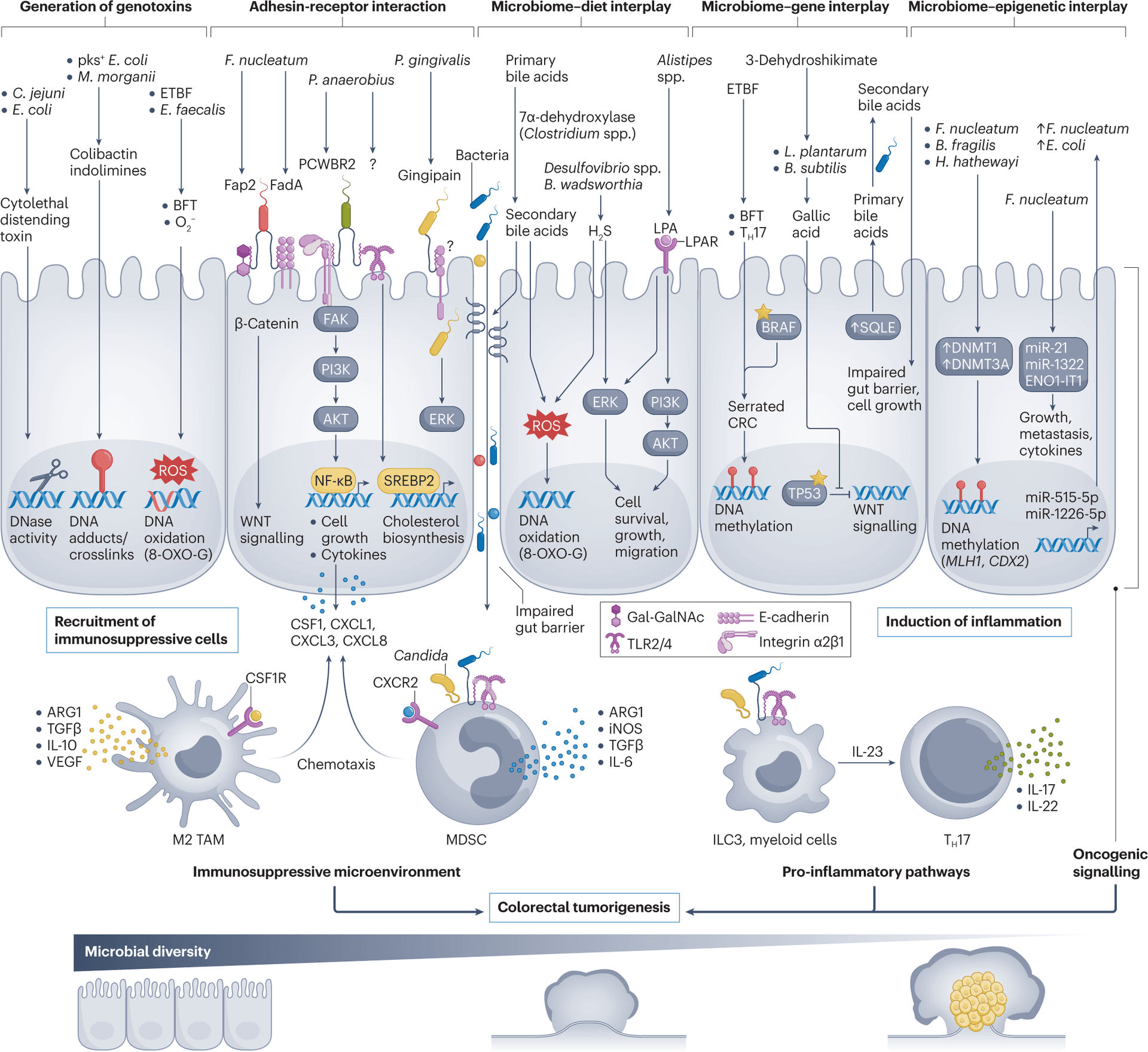
The abstract’s core idea is straightforward, even if the biology is not. A ketogenic diet appears to reduce bacteria in the gut that produce MMA, which the paper treats as an oncometabolite. In the model the authors propose, less MMA means less of the downstream signaling that helps tumors create a friendlier neighborhood around themselves.
Here is the chain they lay out: MMA binds Rap1, Rap1 activates MAPK/ERK signaling, and that signaling pushes tumor-associated macrophages toward the M2 phenotype. If you follow the immunology, that matters because M2 macrophages are generally the pro-tumor side of the macrophage spectrum, the ones that help build an environment tumors can use to grow and spread. In other words, the diet may be changing more than fuel availability. It may be changing who the tumor is recruiting and how those immune cells behave once they arrive.
That is the part keto readers will find most interesting, because it reframes keto from a simple fat-burning tool into a metabolic intervention with possible immune effects. The key word there is possible. The paper offers a pathway, not proof that the pathway is enough to change outcomes in people.
Why the human data matter, but do not close the case
The strongest human hook in the paper is the serum MMA finding. The authors report that elevated serum MMA in colorectal cancer patients correlates with increased M2 macrophage infiltration and worse prognosis. That gives the biomarker a clinical feel, because it links the lab mechanism to patient samples and to outcomes that oncology actually cares about.
Still, correlation is not a treatment recommendation. A higher MMA level can track with worse disease without proving that lowering MMA through diet will reverse the course of cancer, and it certainly does not show that keto by itself can control colorectal tumors. The paper’s own logic points to a tumor microenvironment story, not a standalone therapy story, and that distinction is exactly where careful reporting has to stay planted.
This is also where oncology nutrition coverage needs stricter language than a standard wellness piece. In a cancer setting, readers may understandably want a food-based lever they can control, but the evidence bar is much higher than it is for routine diet advice. A lab mechanism can be promising without being practice-changing, and this paper is still in that promising-but-preclinical lane.
How it fits with earlier keto and microbiome research
This is not the first time keto has shown up in colorectal cancer biology. A 2025 Nature Communications study reported that ketogenic diet consumption produced lasting functional changes in the gut microbiome that were enough to reduce colonic tumor burden in a colorectal cancer mouse model with a humanized microbiome. The same study found that transplanting the microbiome into germ-free mice preserved the tumor-reducing effect, which is a strong clue that the microbes were not just along for the ride.
That earlier work matters because it gives the new Cell Proliferation paper a believable backdrop. If microbiome changes can transfer the anti-tumor effect in mice, then a keto-driven shift away from MMA-producing bacteria is not a wild idea. It is a more focused version of the same theme: diet changes microbes, microbes change signaling, signaling changes the tumor environment.
But the gap between mouse biology and human care is still wide. Human colorectal cancer is not a mouse tumor in a controlled cage, and a microbiome signal in animals is not the same thing as a dietary prescription for patients in treatment.
Why the wording has to stay careful
The American Society of Clinical Oncology has said there is insufficient evidence to recommend for or against ketogenic or low-carbohydrate diets to improve quality of life, treatment toxicity, or cancer control during active treatment. That caution should stay front and center whenever keto and cancer appear in the same sentence. It is the line between interesting science and overreach.
- Keto may influence colorectal cancer biology through the gut microbiome.
- MMA appears to sit in the middle of a signaling chain involving Rap1 and MAPK/ERK.
- The immune endpoint, at least in this model, is a push toward M2 tumor-associated macrophages.
- Human data in the paper support a biomarker link, not a treatment claim.
- Existing oncology guidance still does not support using keto as a cancer therapy.
So the right way to read this paper is as a lab-discovery explainer with guardrails:
That is a lot more nuanced than “keto fights cancer,” and it needs to be. The science here is pointing to a conversation between gut microbes, immune cells, and tumor biology, not a shortcut around oncology care.
The real takeaway is that keto’s relevance in colorectal cancer may have less to do with macros and more to do with the microbiome’s chemistry set. That is a compelling mechanism, but it remains a mechanism, and for now that is where the story should stay.
Every story on Keto Diet Magazine is assembled by an automated editorial system that works from verified research, official records, and credible reporting, then clears automated accuracy and moderation checks before it goes live. The standards that system follows are set and overseen by the people who run the publication. Read our full editorial policy.
Did this article answer your question?