
Keto’s lipid story is no longer a simple win-or-lose debate
The newest systematic review puts the question keto readers care about front and center: which markers usually improve, which ones tend to worsen, and how much do the results vary from one person to the next? In 53 randomized controlled trials in adults, ketogenic diets consistently lowered triglycerides and raised HDL cholesterol, but they also raised LDL cholesterol and total cholesterol. That mixed profile is exactly why keto keeps stirring up arguments in cardiology circles.
What makes this review especially useful is that it does not stop at a single cholesterol number. The authors, including Juanjuan Zhao and colleagues, searched five databases from inception through June 2025, then combined the trial data with subgroup analyses, meta-regression, sensitivity checks, and publication-bias testing. They also used Cochrane Risk of Bias 2 and GRADE to judge how much confidence to place in the findings. In other words, this is not a casual recap of old keto talking points. It is a serious attempt to measure the lipid tradeoff more precisely.
The numbers: lower triglycerides, higher HDL, but LDL moves up too
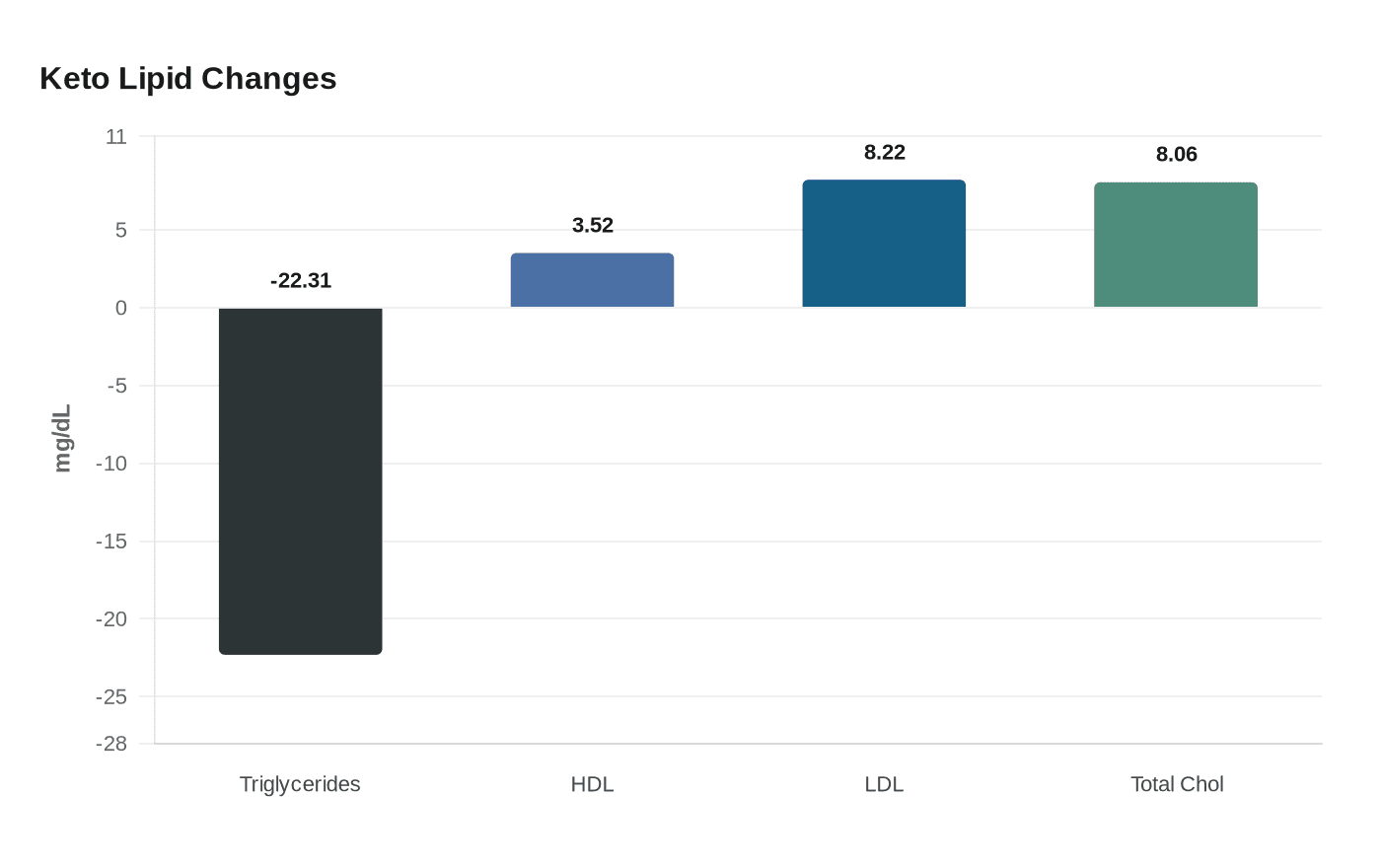
The pooled results show the familiar keto pattern in black and white. Triglycerides fell by 22.31 mg/dL, HDL cholesterol rose by 3.52 mg/dL, LDL cholesterol rose by 8.22 mg/dL, and total cholesterol rose by 8.06 mg/dL compared with control diets. The review rated the certainty as moderate for triglycerides and HDL, but low for LDL and total cholesterol, which matters because the less certain findings are the ones most tied to cardiovascular concern.
For keto readers, the triglyceride and HDL shift is the part that usually feels encouraging. Lower triglycerides and higher HDL often line up with the metabolic improvements people hope for when they cut carbohydrates. But the LDL rise is the part that keeps clinicians cautious, especially when the increase is large enough to move someone from a borderline panel into a clearly concerning range. The review’s message is not that keto is universally good or bad. It is that the direction of change is mixed, and the size of the LDL rise can’t be ignored.
Why this matters more than one cholesterol number
Keto discussions often get stuck on a single LDL value, but this review reinforces why a broader lipid panel matters. Triglycerides, HDL, LDL, and total cholesterol do not all move in the same direction, and the pattern itself is part of the story. A person can look better on triglycerides and HDL while still seeing a rise in LDL and total cholesterol that deserves follow-up.
The review also found a significant negative correlation between HDL change and intervention duration, which suggests the HDL bump may not keep climbing forever as a keto diet continues. That is a reminder that short-term improvements do not always map neatly onto long-term responses. For anyone using keto for weight loss or metabolic health, the practical takeaway is simple: monitor the panel, do not guess from feel alone.
The bigger scientific debate is still unresolved
This new analysis lands in a wider conversation that is already active in cardiovascular medicine. A 2024 review in Nutrition Reviews said consensus has not been reached on the best diet for people with cardiovascular risk factors. That is an important backdrop, because keto has become popular well beyond epilepsy care, especially among people chasing weight loss, better blood sugar control, or lower triglycerides.
A separate 2024 meta-analysis in the American Journal of Clinical Nutrition found a similar split. Ketogenic diets improved triglycerides, blood pressure, weight, and glycemic control, but total cholesterol and LDL cholesterol increased enough that the authors urged caution. That earlier analysis included 27 randomized trials, with durations ranging from 11 days to 12 months, underscoring how much the evidence base has varied in both length and design. The new BMC review adds more trials and a more focused look at adult lipid metabolism, but it lands in the same general place: some markers improve, others worsen.

What major health voices are saying
The public-health messaging around keto has also stayed cautious. Harvard Health summarized a 2024 review as saying keto may not meet standards for a healthy diet and may not be safe for some people with heart disease. HEART UK went in a similar direction in 2024, noting that ketogenic diets are often higher in saturated fats and that randomized trials continue to show higher total and LDL cholesterol alongside lower triglycerides and higher HDL.
That kind of guidance does not mean keto is off-limits for everyone. It does mean the diet should not be treated like a free pass just because glucose or triglycerides look better. If LDL jumps, especially in someone with existing cardiovascular risk, that change deserves attention rather than dismissal.
Why some people see dramatic LDL jumps
One of the most important reasons keto stays controversial is that responses are not uniform. A 2024 paper in JACC Advances described the lean mass hyper-responder phenotype, a group of lean, metabolically healthy people with low triglycerides and high HDL who may be especially prone to very large LDL increases on ketogenic diets. In that report, 80 ketogenic diet participants had LDL-C of at least 190 mg/dL, with a mean LDL-C of 272 mg/dL and an average keto duration of 4.7 years.
That does not mean everyone on keto will see a dramatic LDL spike. It does mean some people do, sometimes to a striking degree, even when the rest of the panel looks impressive. For the keto community, this is the most practical reason to avoid blanket reassurance. If your triglycerides fall and HDL rises, that is good information, but it is not the whole conversation if LDL climbs sharply at the same time.
What this means for day-to-day keto practice
The strongest takeaway from the new review is not panic, and it is not permission to ignore the labs. It is that keto tends to produce a recognizable lipid tradeoff, and your own response may sit anywhere along that spectrum. Some people will see a very favorable triglyceride-to-HDL shift. Others will see LDL rise enough to change the risk discussion entirely.
- Baseline and follow-up lipid testing after starting or intensifying keto
- Attention to the full panel, not just one number
- Extra caution if you already have elevated cardiovascular risk
- A conversation with a clinician if LDL rises substantially or keeps climbing
A smart monitoring plan should include:
The evidence now points in the same direction from multiple angles: keto often improves triglycerides and HDL, but it can also raise LDL and total cholesterol, and the long-term heart impact is still not settled by outcome trials. That is why the most responsible keto approach is not blind optimism or blanket alarm. It is careful tracking, individualized interpretation, and a willingness to adjust the plan when the lipid numbers demand it.
Every story on Keto Diet Magazine is assembled by an automated editorial system that works from verified research, official records, and credible reporting, then clears automated accuracy and moderation checks before it goes live. The standards that system follows are set and overseen by the people who run the publication. Read our full editorial policy.
Did this article answer your question?