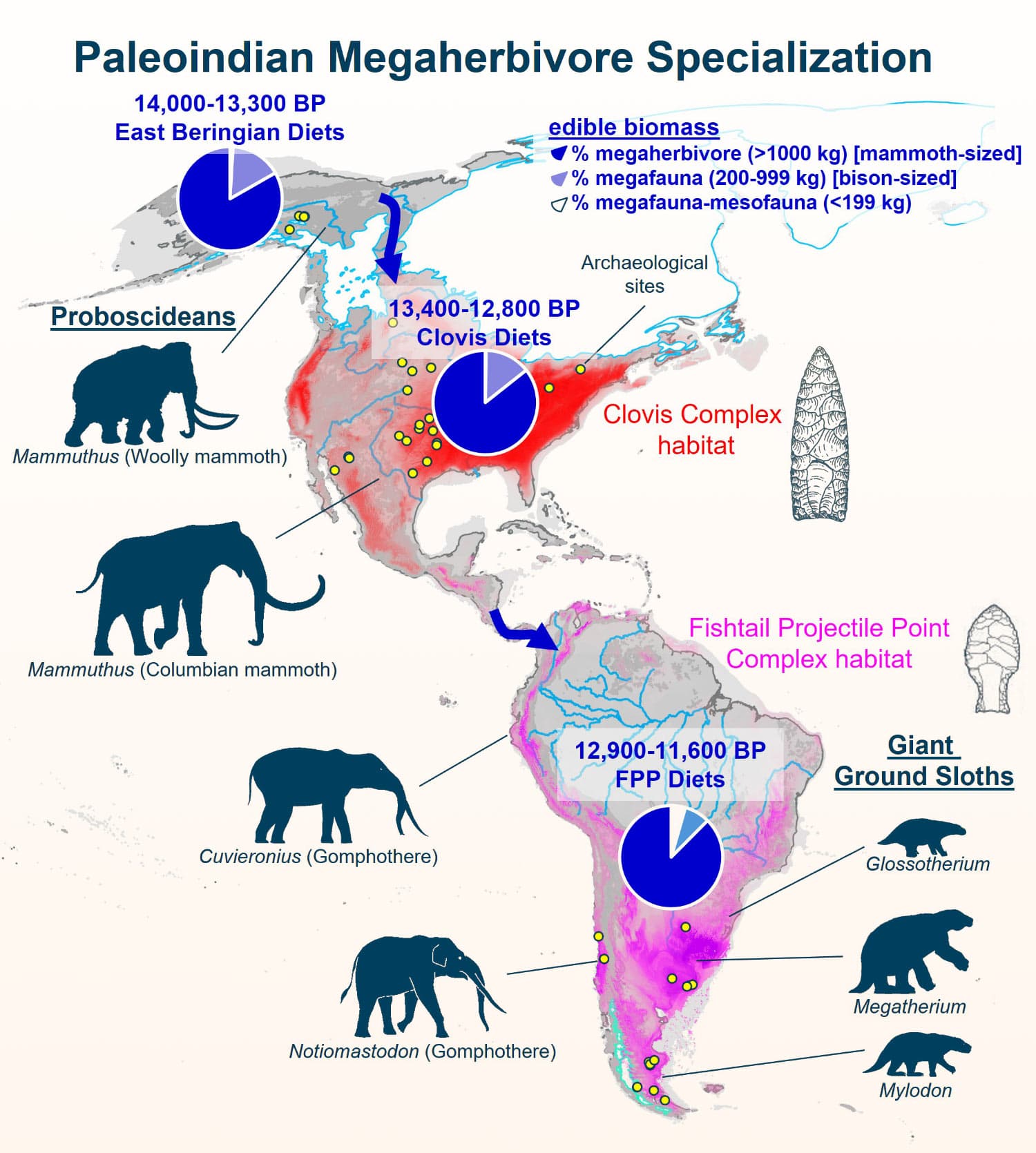
Large mammals supplied at least 98 percent of the diet in some early American regions. The first people to spread across the Americas ran on mammoth meat and fat, but that is a survival story, not a wellness endorsement. A new Science Advances study paints early Paleoindians as specialists in big-game hunting, with food webs shaped by megafauna, scarce plants, and the realities of Ice Age movement across a brutal landscape.
What the new paper actually says
The study, led by Ben Potter of the University of Alaska Fairbanks, pulls together zooarchaeological records from 50 archaeological sites across the Americas. The analysis focuses on three early groups that show up again and again in the archaeological record: Eastern Beringians in Alaska and the Yukon, Clovis people in North America, and Fishtail Projectile Point people in South America.
The Eastern Beringian material falls roughly between 13,300 and 14,000 years ago, Clovis between 12,800 and 13,400 years ago, and Fishtail between 11,600 and 12,900 years ago. In the modeled record, megaherbivores such as mammoths, elephant-like gomphotheres, and giant ground sloths made up 83 percent to 88 percent of the available food.
High-fat, low-carbohydrate eating can emerge naturally when the landscape is built around giant animals, not grocery-store produce.
Why the word “keto” fits, and where it breaks down
Calling this a “keto diet” is useful as shorthand, but only up to a point. The ancient pattern described in the study was shaped by scarcity, mobility, and what Ice Age ecosystems actually offered, not by any modern idea of metabolic optimization, macros, or fat-loss goals. In other words, the resemblance to keto is real at the level of fuel, but it is not a claim that an ancestral template automatically validates today’s version of the diet.
The food mix was dominated by animal fat and protein because mammoths and other megafauna were unusually rich, and because they could be hunted in a way that matched the movement patterns of these early groups. Mammoths were especially valuable because they were fat- and protein-rich, traveled long distances, and offered a relatively reliable resource for highly mobile hunters. That is a very different logic from the modern keto world, where people choose ketosis on purpose and then try to make it sustainable around work, family, and a supermarket shelf.
There is also a practical reason the comparison should not be pushed too far. Early migrants in Eastern Beringia encountered few plant resources, and the archaeological record there shows no clear evidence of fishing.
How this shifts the old archaeology debate
This new paper lands in a long-running argument over whether the first continent-wide Americans were generalists or megafaunal specialists. The old picture often imagined broad-spectrum foragers nibbling whatever was available, but the newer evidence pushes hard in the other direction: big animals were doing most of the work. University of Wyoming researchers say the findings also support the idea that large herbivore extinction was driven primarily by human hunting, while helping explain how early people spread so quickly across very different regions.
Clovis groups transported toolstone over hundreds of miles and used large projectile points attached to darts, which fits a hunting strategy aimed at large, migrating prey rather than a broad pantry of plants, fish, and small game.
The earlier December 4, 2024 Science Advances study sharpened this picture. Using stable isotope analysis on the remains of the mother of the Anzick-1 infant from a 13,000-year-old Clovis burial in Montana, researchers produced the first direct evidence that ancient Americans relied primarily on mammoth and other large animals for food. Prehistoric diet had mostly been inferred indirectly from tools and bones found at campsites; the new paper stretches that conclusion from one Clovis burial to a continent-scale pattern.
What keto readers should take from it
Ancestral eating patterns were often brutally specific to place, time, and ecology. When megafauna were abundant, a high-fat, low-carbohydrate diet could be a natural adaptation; when those animals disappeared, the diet had to broaden because the landscape changed underneath it.
Today’s keto is a chosen diet strategy, usually aimed at weight management, appetite control, or blood-sugar goals. The Ice Age version was an ecological answer to what was in front of you, tied to early American expansion, mammoth hunting, and megafaunal extinction.
Every story on Keto Diet Magazine is assembled by an automated editorial system that works from verified research, official records, and credible reporting, then clears automated accuracy and moderation checks before it goes live. The standards that system follows are set and overseen by the people who run the publication. Read our full editorial policy.
Did this article answer your question?