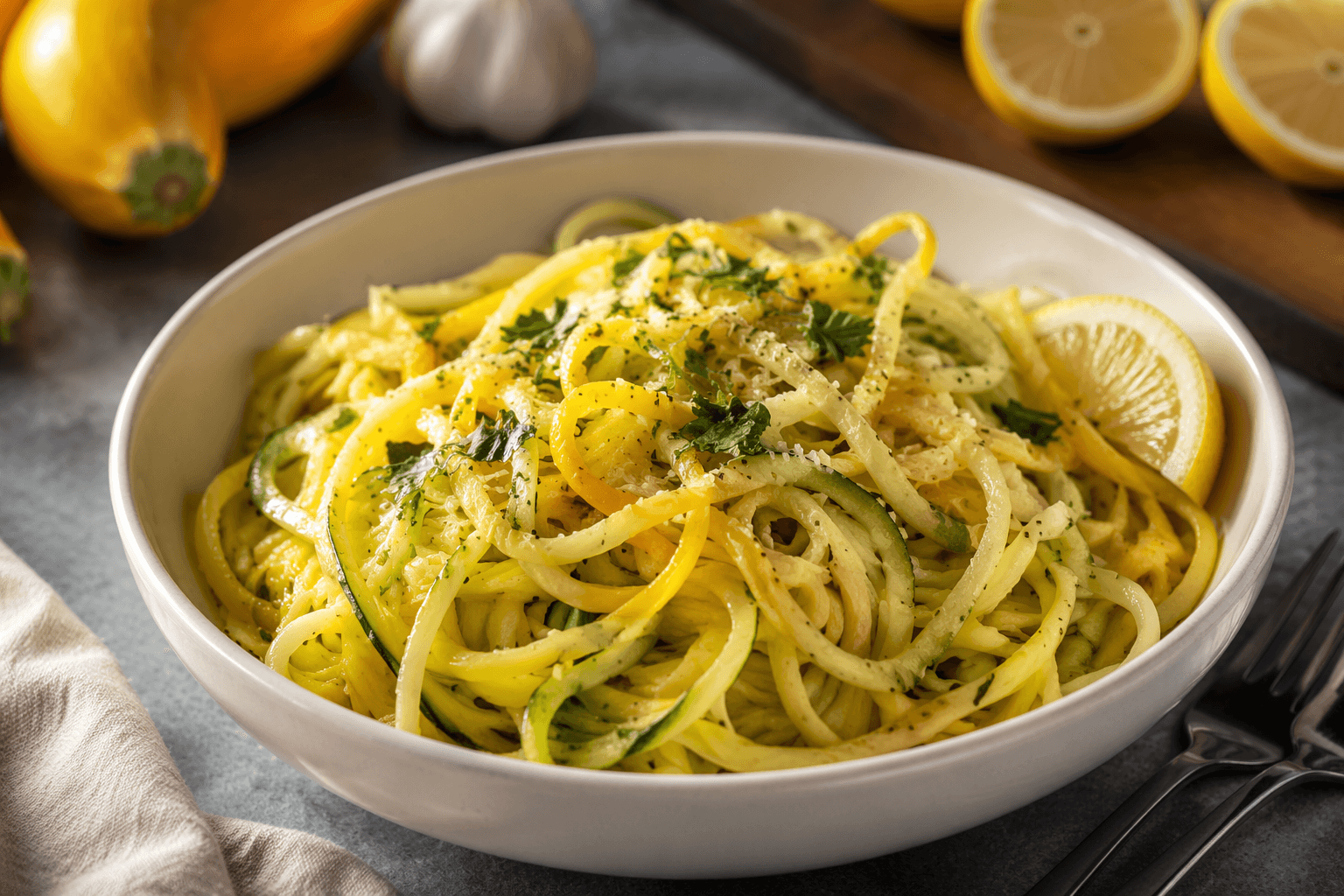
The best keto pasta fixes are the ones that stop pretending to be pasta after the first bite. Amanda C. Hughes’s lemon-garlic yellow squash noodles do exactly that, turning summer squash into a fast, bright dinner with 4 grams of net carbs per serving. The cast iron pan, garlic, herbs, lemon juice, parsley, and almonds give the dish enough bite and payoff that it feels like a real plate of supper, not a compromise.
Why yellow squash belongs in a keto bowl
Keto works because the carb ceiling is tight, and that is exactly where this recipe fits. Mayo Clinic describes keto as a high-fat, very-low-carbohydrate eating pattern, and Mayo Clinic Health System puts the carbohydrate limit at 50 grams a day or less. Hughes’s recipe lands at 151 calories, 14 grams of fat, 6 grams of protein, 2 grams of fiber, and 4 grams of net carbs per serving, with four servings total, which makes it easy to build around chicken, seafood, or another simple protein.
The vegetable itself does a lot of the heavy lifting. USDA FoodData Central lists 1 cup of sliced raw yellow squash at 18 calories, 3.8 grams of total carbs, 1.2 grams of fiber, and 2.6 grams of net carbs. Compared with traditional wheat pasta, which low-carb comparisons usually place around 37 to 43 grams of carbs per serving, the swap is dramatic without needing a fake noodle disguise.
That low-carb logic sits inside a much older medical story. Mayo Clinic says keto was developed more than 100 years ago by Dr. Wilder at Mayo Clinic in Rochester, Minnesota, United States, to treat children with severe epilepsy. Harvard T.H. Chan School of Public Health adds that the diet was used in the 19th century to help control diabetes and was introduced in 1920 as a treatment for epilepsy in children. That history helps explain why a recipe like this focuses on macro fit, repeatability, and speed instead of trying to imitate wheat pasta perfectly.
The texture test is the whole point
This dish succeeds because Hughes understands that texture matters as much as flavor. She makes the case that shaved yellow squash has a better mouthfeel than zoodles, and the method backs her up: the squash is shaved into noodle-like ribbons, then sautéed quickly in a cast iron pan so it stays tender without turning limp. That matters in summer, when gardens are full of squash that can go tired and watery fast.
The moisture problem is the part that usually sinks vegetable noodles, so the fix is straightforward: start with fresh squash, keep the ribbons thin, and cook them hot and fast. You want the pan to do just enough work to soften the squash and drive off excess liquid, not so much that the ribbons collapse into a slippery pile. Lemon juice finishes the dish with brightness rather than heaviness, which keeps the whole bowl from tasting flat.
A few practical habits make the swap work even better:
- Shave the squash into even ribbons so it cooks uniformly.
- Sauté it briefly in a hot cast iron pan to reduce water fast.
- Add the lemon at the end so the flavor stays clean and sharp.
- Keep the parsley and almonds in the final toss for freshness and a little crunch.
That is also why this swap can beat shirataki or palmini on the right night. If you want a bowl that tastes like actual produce, with a fresh squash flavor and a lighter, brighter finish, yellow squash is the better fit. Shirataki and palmini can satisfy the carb count, but this version gives you a vegetable-forward dinner that still feels like dinner.
A recipe with staying power, not novelty
Hughes’s own site says she has been developing ketogenic recipes since 2010 and describes her as the author of several best-selling cookbooks. That background shows in the recipe’s tone: it reads like the work of someone who has spent years building low-carb meals that people will actually cook again. The fact that this is a republished alternative version of a recipe she first posted in 2012 tells you the idea has already survived the hardest test in keto cooking, which is whether it still solves the same problem a decade later.
The lemon-garlic finish is the other reason it holds up. Garlic gives the dish backbone, herbs keep it green and fresh, and the lemon keeps the squash from feeling like a heavy substitute for pasta. Because the recipe stays light, it leaves room for whatever protein is already on the menu, which is the kind of weeknight flexibility keto cooks rely on when they do not want to think too hard about dinner.
Wicked Stuffed’s 2026 recipe lineup also includes other squash-forward dishes such as Lemon Cream Chicken Over Squash Ribbon Pasta, which shows how central summer squash has become in Hughes’s low-carb kitchen. This is not a one-off trick built to chase a trend. It is a repeatable answer to the same old pasta-night problem, and it works because it leans into what yellow squash does well instead of asking it to be something it is not.
When pasta night starts feeling like a compromise, this is the rescue that makes sense: a pan of yellow squash, hot garlic, a squeeze of lemon, and a four-net-carb plate that tastes like summer rather than substitution.
Every story on Keto Diet Magazine is assembled by an automated editorial system that works from verified research, official records, and credible reporting, then clears automated accuracy and moderation checks before it goes live. The standards that system follows are set and overseen by the people who run the publication. Read our full editorial policy.
Did this article answer your question?