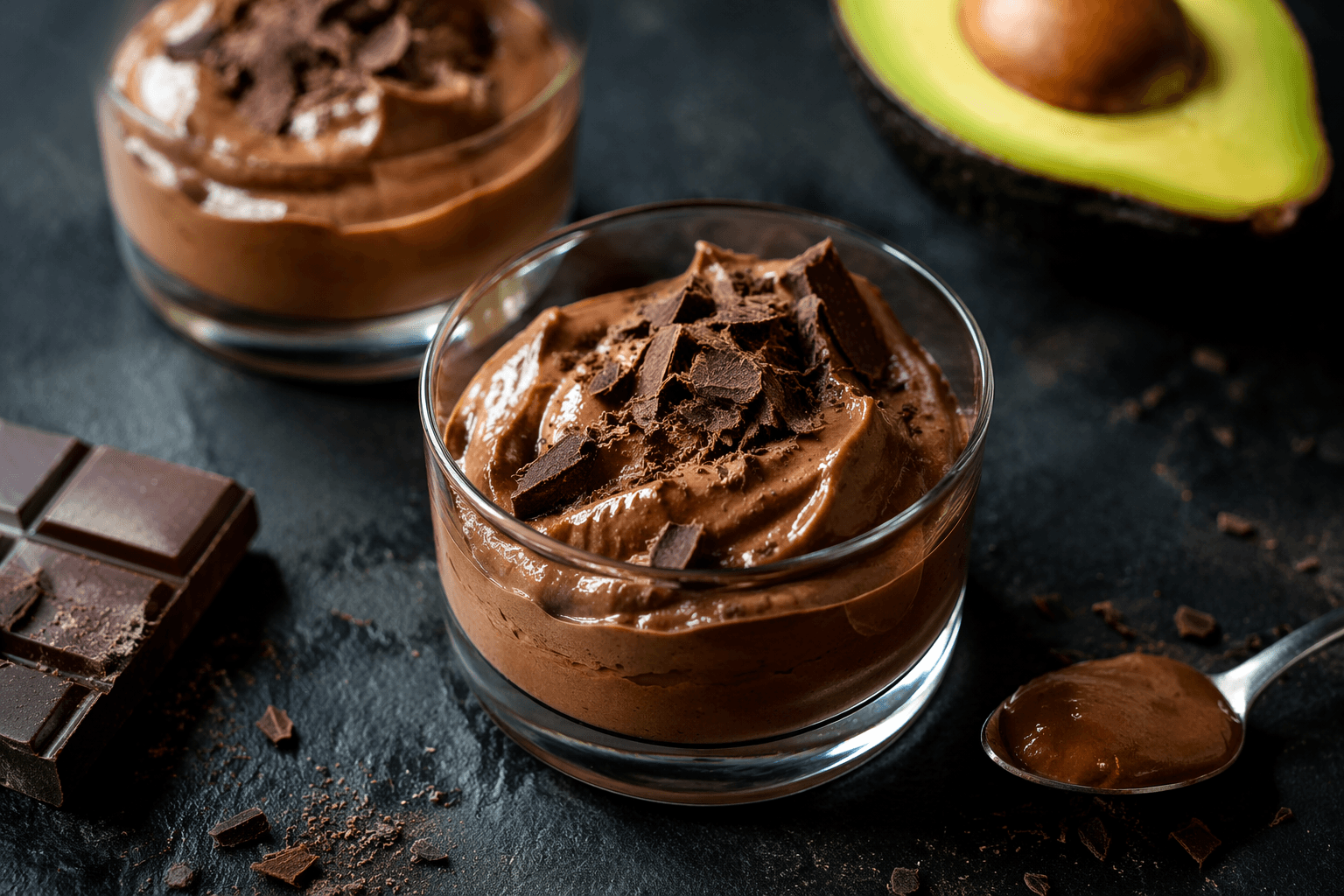
After nearly a year on keto, a square of dark chocolate no longer felt like enough. In her July 10 guide, Maya Ellison answered that problem with an avocado chocolate mousse so satisfying it won over even her non-keto husband. The recipe is built for the moment when the sweet tooth hits hard.
Dessert psychology starts with the right goal
Dessert is part of adherence, not an afterthought. Healthy By Fork focuses on light, low-calorie recipes for busy lifestyles, with categories that include guilt-free desserts and quick meals, and this recipe page combines one full mousse recipe with a few additional keto treat ideas from the site. A keto dessert does not need to pretend to be a bakery clone; it needs to be something you actually want to finish.
A lot of keto dessert disappointment comes from trying to make a conventional dessert feel “lighter” instead of making a keto dessert feel complete on its own terms. Ellison’s mousse takes a different path, built around richness, spoonable texture, and a portion that feels like a real treat.
Net carbs are the number that decides whether dessert fits
Net carbs are total carbohydrates minus fiber. That is the number most keto eaters use when deciding whether a dessert belongs in the day, and Ellison says truly keto-friendly desserts should generally stay under 10 grams of net carbs per serving. Across recipe sites, some aim for under 5 to 6 grams, while others use a looser under-8-to-10-gram standard, so the exact ceiling can vary.
Ellison’s own mousse lands in a useful middle ground at about 150 calories and 6 grams of net carbs per serving. That profile is part of why the recipe feels realistic rather than aspirational, especially for anyone who has learned the hard way that a dessert can look keto on a page and still blow up a day’s carb budget in practice.
Why avocado, chia, almond flour, and full-fat dairy work
Keto desserts succeed when fat is doing the job sugar and flour usually do. Calories are often higher than people expect because fat replaces the ingredients that normally provide fluff, sweetness, and bulk, and that is exactly why avocado, chia, almond flour, and full-fat dairy show up so often in this style of cooking. They add body without loading the recipe with digestible carbs, which is the difference between a dessert that feels substantial and one that disappears the moment you taste it.
Avocado is especially well suited to this job. Avocados are rich in monounsaturated fats, fiber, potassium, and carotenoids, and the U.S. Food and Drug Administration puts saturated fat at 0.5 grams per ounce. In a mousse, that nutrient profile translates into a texture that reads as creamy instead of watery, and a finish that feels luxurious without relying on sugar to carry it.
How to tell a keto dessert will actually satisfy you
The quickest way to avoid wasting ingredients on a substitute that never feels rewarding is to check for the same things your favorite non-keto dessert gives you: body, sweetness, and a finish that lingers. A good keto dessert does not need to be airy in the old-fashioned sense, but it does need enough structure to feel intentional, and enough sweetness to register as dessert instead of a snack pretending to be one.

A simple checklist helps:
- Richness comes from fat, not from added starches that can push carbs up fast.
- Sweetness should be concentrated enough to read clearly against the avocado or dairy base.
- Portion size should match the macro target, because even a perfect mousse still needs to fit the day.
- Texture matters as much as flavor, since a creamy set is what makes the spoonful feel finished.
The bigger keto context behind the recipe
The ketogenic diet began in the 1920s as a treatment for pediatric drug-resistant epilepsy, designed to mimic fasting, then faded as anticonvulsant drugs became available before returning to the mainstream as a weight-loss approach.
Even within that modern version, there is no single rulebook. Mayo Clinic’s Healthy Keto meal plan keeps net carbs around 50 grams per day, and Mayo Clinic links low-carb diets to weight loss and blood sugar management. At the same time, its materials caution that strict keto can bring constipation, nutrient deficiencies, and other side effects, while the American Heart Association said in 2023 that ketogenic diets contradicted its heart-healthy eating guidance.
Every story on Keto Diet Magazine is assembled by an automated editorial system that works from verified research, official records, and credible reporting, then clears automated accuracy and moderation checks before it goes live. The standards that system follows are set and overseen by the people who run the publication. Read our full editorial policy.
Did this article answer your question?