
The real fight is not whether keto works, but when it stops working
Keto can turn an athlete into a fat-burning machine and still leave that athlete getting outkicked at the line. That is the heart of the endurance debate now playing out in nutrition circles: low-carb and ketogenic diets may change metabolism dramatically, but whether that helps on race day depends on the event, the pace, and how long the body has had to adapt.
The American Society for Nutrition’s latest debate, built around the American Journal of Clinical Nutrition’s Great Debates in Nutrition series, frames the issue as one of the field’s most persistent questions. The series sets up two opposing papers and a consensus paper on whether low-carbohydrate eating impairs endurance sports performance, which is a useful way to force the conversation away from ideology and toward practical tradeoffs.
What Burke’s data says about fat burning and race-day cost
Louise Burke’s side of the debate is blunt: ketogenic adaptation can drive fat oxidation through the roof, but that does not automatically translate into faster racing. In her elite race-walker work, athletes followed three energy-matched diets: high carbohydrate availability, periodized carbohydrate, and a low-carbohydrate, high-fat plan that kept carbs under 50 g per day and pushed fat to about 78% of energy intake.
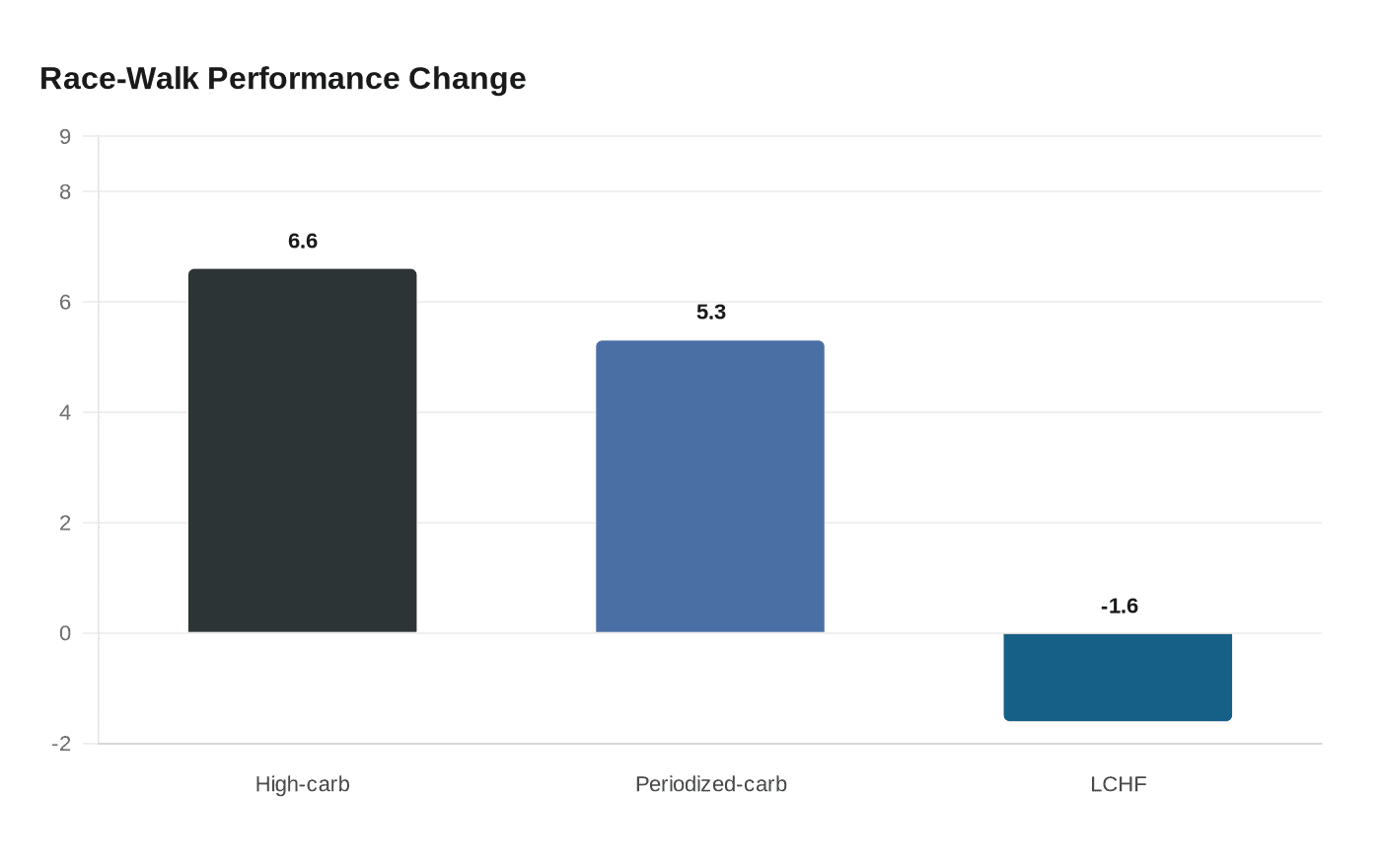
The result that keeps coming up is simple and uncomfortable for keto fans who want a universal win. In the 2017 race-walker trial, the LCHF group hit a peak whole-body fat oxidation rate of 1.57 ± 0.32 g/min during 2 hours of walking at 80% VO2peak, which is an impressive metabolic shift. But the same study also showed the cost: 10 km race-walk performance improved by 6.6% in the high-carb group and 5.3% in the periodized-carb group, while the LCHF group did not improve, posting a -1.6% change.
That is the tradeoff in plain English. Yes, the body can become far better at using fat. No, that does not mean it will move faster when race intensity is high and oxygen economy matters. Burke’s argument is that carbohydrates remain the more oxygen-efficient fuel, so when an athlete is operating near max output, a heavy reliance on fat can force a slower pace.
The follow-up study made the same point even harder to ignore
The 2020 follow-up sharpened the case instead of softening it. After 25 days of supervised training, elite male and female race walkers on LCHF again showed higher fat oxidation, but they were slower in 10,000 m performance by 2.3%. The study also looked for a rescue effect after 2.5 weeks of high-carbohydrate restoration before a 20 km race and found no detectable rebound advantage.
That detail matters because it knocks out one of the most common keto reassurances: that a hard carb reload will erase the penalty once the event gets serious. In this case, it did not. The athletes adapted metabolically, but the performance gap in a race-specific setting remained.
The wider lesson from Burke’s work is not that keto is useless. It is that the sport has to match the fuel strategy. The more the event rewards steady output at a lower intensity, the more a high-fat engine can make sense. The more the event demands surges, pace changes, and high-end speed, the more carbohydrate availability starts looking like the difference between hanging on and fading.
What Noakes says the keto conversation has been missing
Timothy Noakes pushes back on the old assumption that endurance athletes must stay carbohydrate-loaded to perform well. His position is that with proper adaptation, usually in the four- to six-week range, athletes can perform similarly on high-carb and low-carb diets. He also argues that the real problem in long events may be low blood glucose, not low muscle glycogen alone.
That distinction is important because it changes the way carbs are viewed during exercise. In Noakes’ review in Endocrine Reviews, carbohydrate ingestion is presented mainly as a tool to prevent exercise-induced hypoglycemia, especially in prolonged efforts lasting more than two to three hours. In other words, the carbs may be helping the brain and blood sugar more than rescuing the muscles.
The review also cites a study showing no difference in prolonged submaximal exercise performance after six weeks on either a high- or low-carbohydrate diet, even though the low-carb group had lower glycogen and carbohydrate oxidation. That is the strongest version of the pro-keto argument: if the body adapts well enough, performance can stay steady even when the metabolic machinery looks very different on paper.
Where the evidence actually lands for endurance athletes
The cleanest takeaway from the debate is that the answer changes with the demands of the sport. Current competition nutrition guidance still pushes high carbohydrate availability because that remains the safest way to optimize endurance performance, especially for racing where intensity matters as much as duration. The Great Debates framing is useful precisely because it refuses to pretend one diet solves every event.
For steady-state efforts, long training blocks, and athletes who care more about metabolic flexibility than absolute speed, keto may have a place. For all-out race walkers, cyclists, runners, and triathletes trying to hold a hard pace, Burke’s data keeps showing the same thing: bigger fat oxidation does not automatically buy better performance. It can buy a more impressive fuel profile and a worse finishing time.
The adaptation timeline is another trap for casual readers. Four to six weeks of low-carb adaptation is not a magic switch, and the elite studies Burke ran show that even after meaningful adaptation, performance can still lag. If you are testing keto because you want a quick boost before a race, the evidence here is not friendly to that plan.
The practical read for keto athletes
If you want the honest, field-tested version, it looks like this:
- High-fat adaptation can raise fat oxidation sharply, and in Burke’s race-walker study it reached 1.57 ± 0.32 g/min.
- That metabolic gain can come with a performance penalty in high-intensity endurance work, especially when race pace depends on oxygen efficiency.
- The best-supported keto use case is not all-out racing speed. It is more likely to fit athletes doing longer, steadier efforts or those prioritizing a different metabolic feel in training.
- If your event lasts longer than two to three hours, carbohydrate intake may matter most as a guard against low blood glucose, not just as a glycogen top-up.
- A four- to six-week adaptation window is the minimum serious keto conversation should even start with. Anything less is usually just a half-finished experiment.
The debate is not a referendum on keto as a lifestyle. It is a reality check for athletes who want a sports-performance answer. Fat burning is real, adaptation is real, and so is the cost when a race turns fast. That is why the conversation keeps coming back to the same practical question: for which sport, at what intensity, and for whom? The answer is still changing, which is exactly why Louise Burke and Timothy Noakes are still worth arguing over.
Every story on Keto Diet Magazine is assembled by an automated editorial system that works from verified research, official records, and credible reporting, then clears automated accuracy and moderation checks before it goes live. The standards that system follows are set and overseen by the people who run the publication. Read our full editorial policy.
Know something we missed? Have a correction or additional information?
Submit a Tip